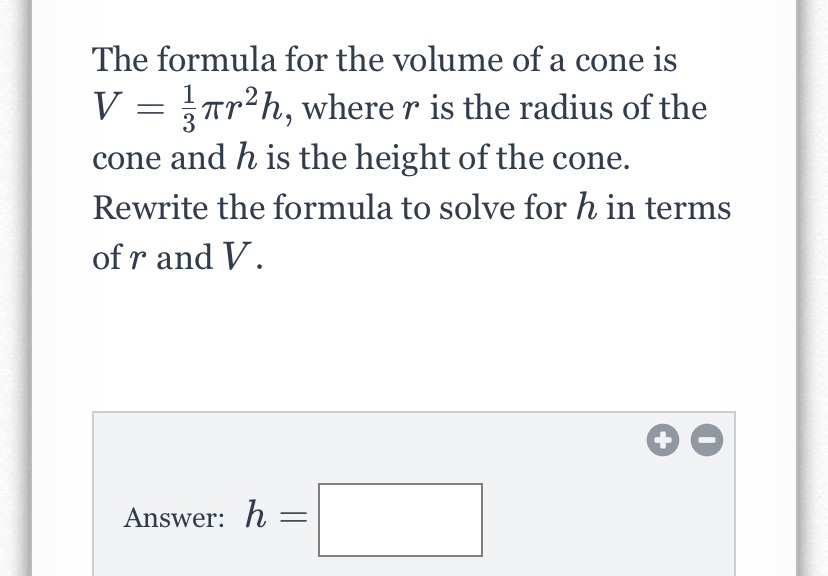
Formula For Volume Of A Cone In Terms Of H For example, the space that a substance or 3D shape occupies or contains. Volume is often quantified numerically using the SI derived unit, the cubic metre. Volumes of some simple shapes, such as regular, straight-edged, and circular shapes can be easily calculated using arithmetic formulas.

Volumes of complicated shapes can be calculated with integral calculus if a formula exists for the shape's boundary. One-dimensional figures and two-dimensional shapes are assigned zero volume in the three-dimensional space. Rational formulas can be used to solve a variety of problems that involve rates, times, and work.

Direct, inverse, and joint variation equations are examples of rational formulas. In direct variation, the variables have a direct relationship—as one quantity increases, the other quantity will also increase. As one quantity decreases, the other quantity decreases.
In inverse variation, the variables have an inverse relationship—as one variable increases, the other variable decreases, and vice versa. Joint variation is the same as direct variation except there are two or more variables. We can derive the formula for the volume of the cone by using integration. For this, we will come up with a function in the Cartesian plane and then rotate this function about one axis. We will get a solid of revolution, a three-dimensional object, which will be the cone. We write the slant height in terms of the radius and height of the cone.
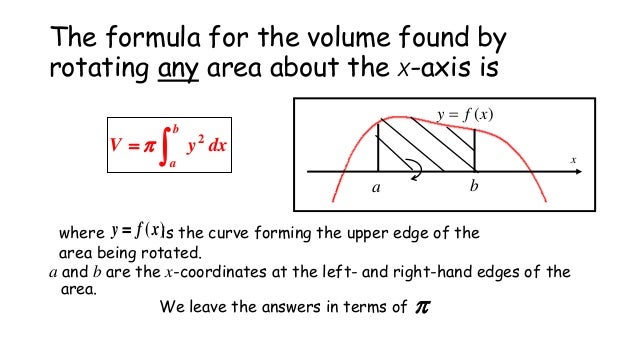
Then we integrate along the height of the cone to obtain the volume of the cone. Take a cylindrical container and a conical flask of the same height and same base radius. Add water to the conical flask such that it is filled to the brim. Start adding this water to the cylindrical container you took. You will notice it doesn't fill up the container fully. Try repeating this experiment for once more, you will still observe some vacant space in the container.
Repeat this experiment once again; you will notice this time the cylindrical container is completely filled. Thus, the volume of a cone is equal to one-third of the volume of a cylinder having the same base radius and height. Is the shape of a basketball, like a three-dimensional circle. Just like a circle, the size of a sphere is determined by its radius, which is the distance from the center of the sphere to any point on its surface. The formulas for the volume and surface area of a sphere are given below.
Conical and pyramidal shapes are often used, generally in a truncated form, to store grain and other commodities. Similarly a silo in the form of a cylinder, sometimes with a cone on the bottom, is often used as a place of storage. It is important to be able to calculate the volume and surface area of these solids. If a cone and cylinder have the same height and base radius, then the volume of cone is equal to one third of that of cylinder. That is, you would need the contents of three cones to fill up this cylinder.

The same relationship holds for the volume of a pyramid and that of a prism . Learn how to calculate the volumes of a pyramid, frustum, and cone. Discover the formulas for calculating each shape's volume and how similar triangles can be used to determine the volume of a frustum. Let's get right to it — we're here to calculate the surface area or volume of a right circular cone.

As you might already know, in a right circular cone, the height goes from the cone's vertex through the center of the circular base to form a right angle. Right circular cones are what we typically think of when we think of cones. The figure above also illustrates the terms height and radius for a cone and a cylinder.
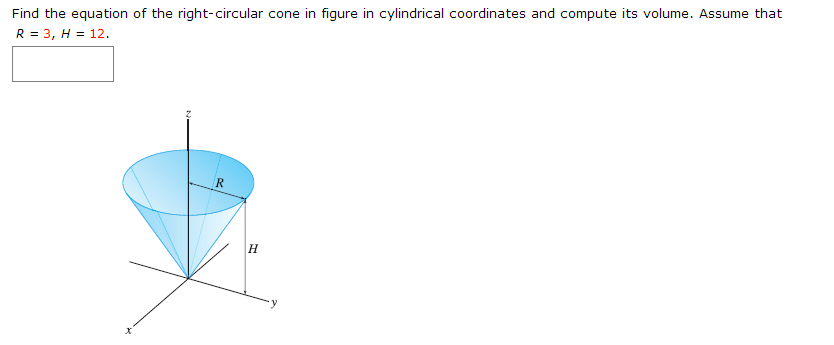
The height of the cone is the length h of the straight line from the cone's tip to the center of its circular base. Both ends of a cylinder are circles, each of radius r. The height of the cylinder is the length h between the centers of the two ends.

A conical surface is a ruled surface created by fixing one end of a line segment at a point and sweeping the other around the circumference of a fixed circle . With the Pythagorean theorem, use the radius and the height to calculate the slant height of the cone, then multiply the slant height by the radius by pi. To that you add the base area of the cone, which is found by multiplying pi by the square of the radius. The total surface area is found by adding the lateral surface area to the base area. In this module, we will examine how to find the surface area of a cylinder and develop the formulae for the volume and surface area of a pyramid, a cone and a sphere. These solids differ from prisms in that they do not have uniform cross sections.

You can think of a cone as a triangle which is being rotated about one of its vertices. Now, think of a scenario where we need to calculate the amount of water that can be accommodated in a conical flask. In other words, calculate the capacity of this flask.

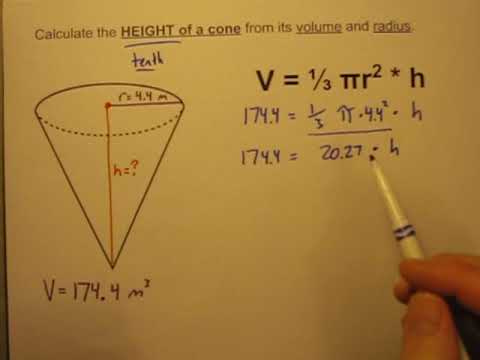
The capacity of a conical flask is basically equal to the volume of the cone involved. Thus, the volume of a three-dimensional shapeis equal to the amount of space occupied by that shape. Let us perform an activity to calculate the volume of a cone. In general, a cone is a pyramid with a circular cross-section. A right cone is a cone with its vertex above the center of the base. You can easily find out the volume of a cone if you have the measurements of its height and radius and put it into a formula.

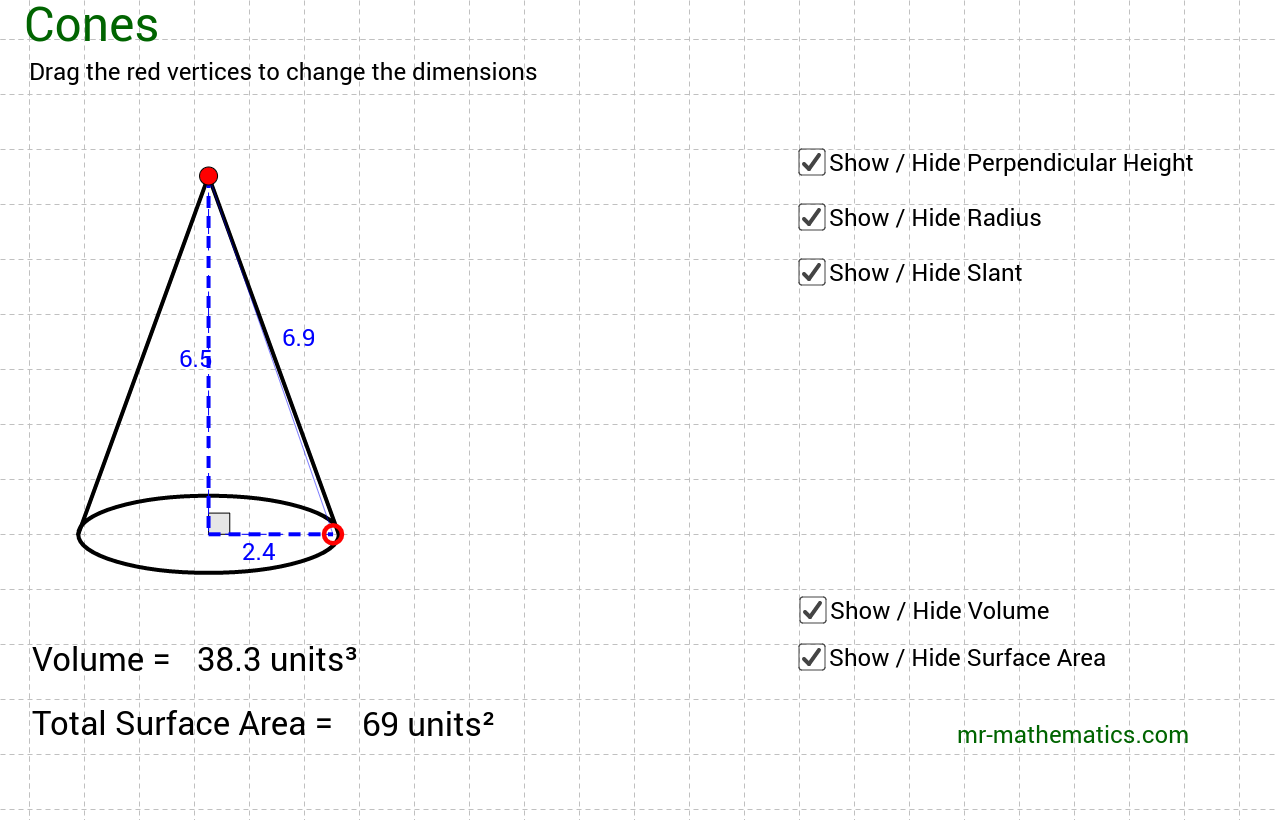
Given slant height, height and radius of a cone, we have to calculate the volume and surface area of the cone. In geometry, a cone is a solid figure with one circular base and a vertex. The height of a cone is the distance between its base and the vertex.The cones that we will look at in this section will always have the height perpendicular to the base. In a cone, the perpendicular length between the vertex of a cone and the center of the circular base is known as the height of a cone. A cone's slanted lines are the length of a cone along the taper curved surface.
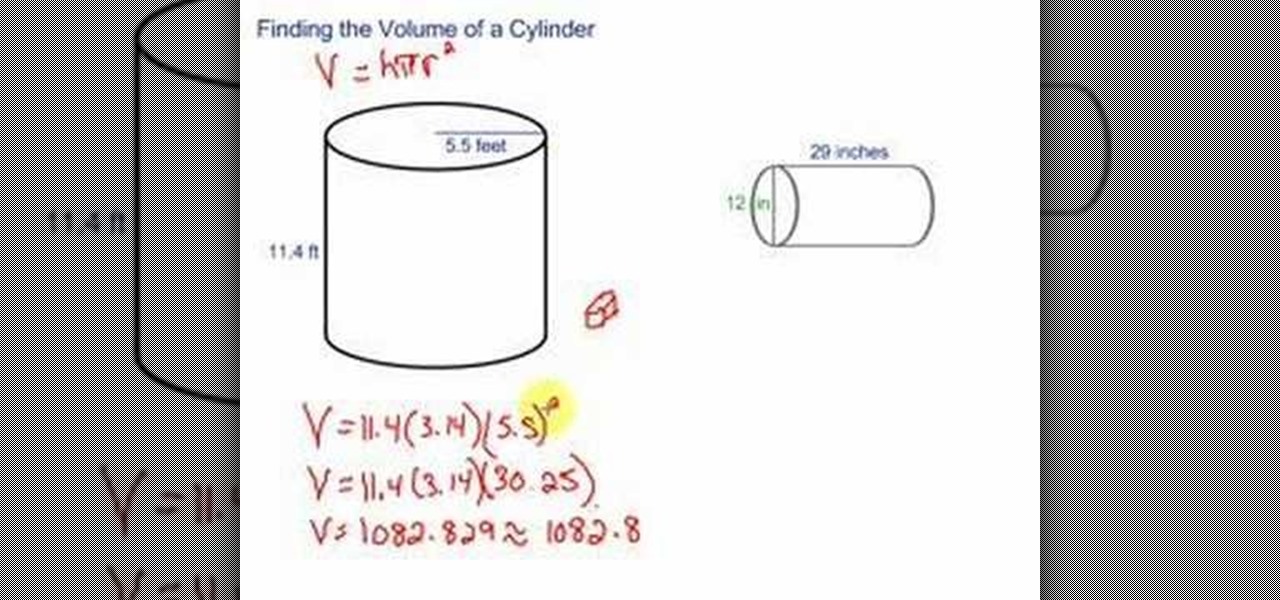
All of these parameters are mentioned in the figure above. In geometry, a cone is a 3-dimensional shape with a circular base and a curved surface that tapers from the base to the apex or vertex at the top. In simple words, a cone is a pyramid with a circular base. Is a solid figure with one circular base and a vertex. Generally, volumes of pyramids and cones are easy to calculate.

Multiply 1/3 times the area of the base times the height. The height is a line perpendicular to the base reaching the peak. The slant height of a cone should not be confused with the height of a cone. Slant height is the distance from the top of a cone, down the side to the edge of the circular base. Slant height is calculated as \(\sqrt\), where \(r\) represents the radius of the circular base, and \(h\) represents the height, or altitude, of the cone.
Think of volume as the amount of liquid that you could fill an object with, and think of surface area as how much paper you could wrap over that object. Every cube, sphere, cylinder, cone , and so on has a volume and a surface area; and the formulas used for finding these measurements is different for each shape. I just did a demonstration with my class that took about 2 minutes.

Granted it was just inductive reasoning but it satisfied the students for now. I had 2 pairs of students come up to the front of the class. Each pair had solids with a congruent base and height. The person with the cone had to see how many times they could fill the cone with water and fit it into the cylinder. Similarly the person with the pyramid had to see how many times they could fill the pyramid with water and fit it into the prism.
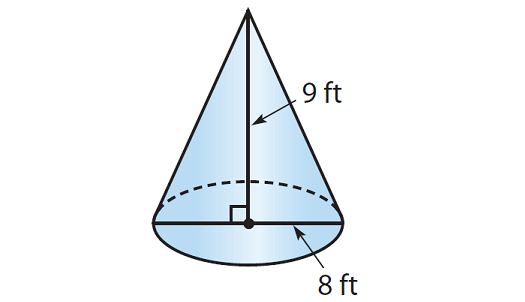
There is special formula for finding the volume of a cone. The volume is how much space takes up the inside of a cone. The answer to a volume question is always in cubic units.

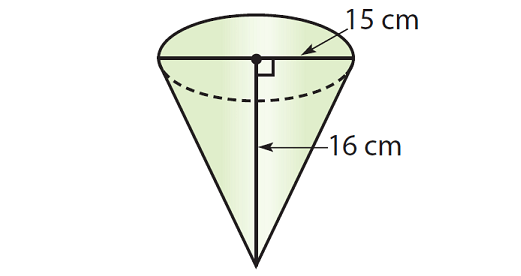
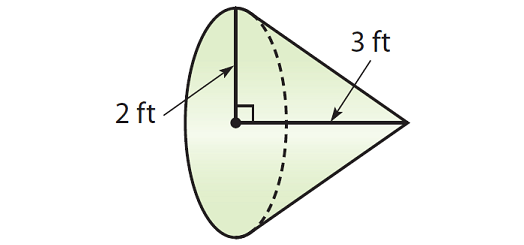
Let us consider an example where we use the formula for the volume of a cone given a diagram. The volume of a cone defines the space or the capacity of the cone. A cone is a three-dimensional geometric shape having a circular base that tapers from a flat base to a point called apex or vertex. A cone is a three-dimensional figure with one circular base. A curved surface connects the base and the vertex.
Volume is the amount of total space on the interior of the solid. Knowing the definition of volume, we can now focus on the formulas for volume of common geometric solids. Using these formulas manually won't be difficult, but for fast, accurate results every time, use the volume calculator. Filled cones with circular base radius , base center , and vertex are represented in the Wolfram Languageas Cone. Let's look at another example of direct variation.

Mary works at a roadside stand on the family chicken farm, selling eggs for $1.99 per carton on busy weekends. When customers buy a lot of cartons at once, she has to add up the totals with a pencil and paper, and she worries about making mistakes. Lucky for Mary, this is a direct variation relationship—the output equals the input times a constant . She can use a direct variation equation to make a pricing table to use as a shortcut. Use calculus to find the volume of a frustum of a right circular cone with height h| lower base radius R| and top radius n.

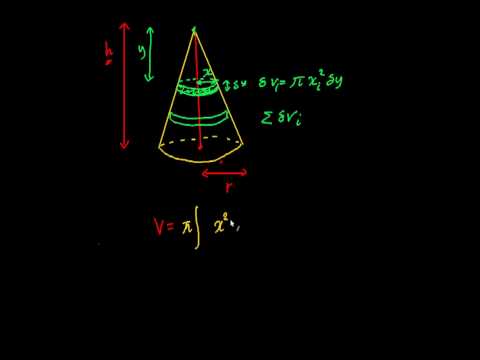
I then observed how the volume of the cone could be approximated by using disks, the width of each being the height of the cone divided by the number of disks. So, the volume as a function of x would be the area as a function of x times the height divided by n, or the number of disks. Then we will study the figure and describe the elements that make the cone.

After that, we will give the formula for the volume of the cone. We will look at the relation of the volume of a cone with the volume of a cylinder that has the same radius and height. We will give an example of the application of the formula for the volume of a cone. This online calculator will calculate the various properties of a right circular cone given any 2 known variables. The term "circular" clarifies this shape as a pyramid with a circular cross section. The term "right" means that the vertex of the cone is centered above the base.

Using the term "cone" by itself often commonly means a right circular cone. We are finding the total surface area of a cone so we find the curved surface area and add on the area of the circular base. In this section, we will finish our study of geometry applications. We find the volume and surface area of some three-dimensional figures.
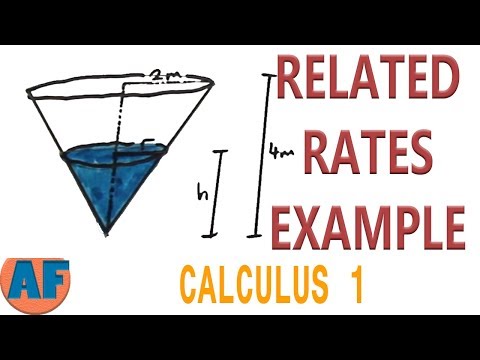
Since we will be solving applications, we will once again show our Problem-Solving Strategy for Geometry Applications. Notice that this relation expresses the water's volume as the function of two variables, r and h. We can only take the derivative with respect to one variable, so we need to eliminate one of those two. Use Reynolds transport theorem to determine the rate at which the cone's volume is increasing when the cone's base radius is ro if its height is h. In this method, you are basically calculating the volume of the cone as if it was a cylinder. When you calculate the area of the base circle, and multiply it by the height, you are "stacking" the area up until it reaches the height, thus creating a cylinder.
And because a cylinder can fit three cones of its matching measurements, you multiply it by one third so that it's the volume of a cone. Instead of handing out math worksheets on calculating volume, show how the volume of different figures is measured in different units. Show how to take the overall measurements of a cube, cuboid or sphere-shaped object and then compute its volume.
Also, discuss the unit in which the volume will be determined and how it will differ in each case. The faces bounding a right pyramid consist of a number of triangles together with the base. To find the surface area, we find the area of each face and add them together. Depending on the information given, it may be necessary to use Pythagoras' Theorem to calculate the height of each triangular face. If the base of the pyramid is a regular polygon, then the triangular faces will be congruent to each other.

The "height" of a cone, and the "slant height" of a cone are not the same thing. The height of a cone is considered the vertical height or altitude of the cone. This is the perpendicular distance from the top of the cone down to the center of the circular base.

The slant height of a cone is the distance from the top of the cone, down the side of the cone to the edge of the circular base. First, I put a cone on a Cartesian plane, with the tip at the origin. Thus, an equation to describe the radius would be the radius over the height times x. Then, I substituted this equation into pi r squared to get cross sectional area as function of x. To find the combined area of the base and sides, you need the slant height of the cone, l.


No comments:
Post a Comment
Note: Only a member of this blog may post a comment.